Landlust is Oracle's CTO for the EMEA region. At Data Expo, he spoke about the partnership the company entered into with Red Bull for Formula 1 in 2021. As his presentation revealed, this partnership is wide-ranging.
The premier class of motorsports is massive. To illustrate its scale, the Dutchman began by asking the audience a question: How many people actually work for a Formula 1 team? “Who thinks it’s more than five hundred? Who thinks more than a thousand? There are more than two thousand,” he clarified. “You’re actually talking about a large company, with the difference that everything comes together in two cars.” Data and the cloud play a key role in the team’s success, both on the track and off.
 Strategy is at the heart of the race."
Continuous probability calculations
Landlust outlined several areas of collaboration with the team, for which Max Verstappen has been driving for over ten years now. The driver recently extended his contract with the team. The most striking aspect is the strategy on race day. “Strategy is at the heart of the race, ” said Landlust. “What do you do at any given moment? That involves pit stops, tires, the battery, the safety car, and the weather. OCI (Oracle Cloud Infrastructure, ed.) facilitates continuous probability calculations for specific scenarios, in real time.” Based on that, the team makes strategic decisions: when to enter the pit lane? Which tires? “It comes down to thinking at lightning speed. During an average race weekend, we run 1 billion to as many as 3 billion so-called Monte Carlo simulations. We provide the infrastructure; the team builds the model.”
From simulation to World Championship
The simulations can make the difference between winning and losing, as was evident during the decisive 2021 Abu Dhabi Grand Prix. The Red Bull team (which at the time did not yet have “Oracle” in its name) brought Verstappen in during a late safety car period for fresh soft tires, while Lewis Hamilton continued on his old hard tires. At the restart, Verstappen passed his rival on the final lap, securing his first world title. “The computer said that’s what we had to do.”
“We provide the infrastructure; the team builds the model”
Magical
The cloud makes it possible to scale capacity up or down as needed, Landlust continued his story at Data Expo. “You can manage your resources in an agile and flexible way. I call that the magic of the cloud . I’m a true IT guy, I was already working in the cloud before it was even called that.” The CTO then posed another question to the audience: How much would all those billions of simulations cost over a weekend like this? Most visitors overestimated the cost by a wide margin: it’s only 150 British pounds. Meanwhile , the mountain of data on which the simulations are based continues to grow.
New generation of engines
Simulations also played a key role in the development of a new generation of engines: starting this season, Oracle Red Bull Racing is competing under new Formula 1 rules with a power unit the team developed in collaboration with Ford. “A fundamental change,” according to Landlust. “Sustainable, innovative, and fast. We ran simulations at every stage of the development process. That helps avoid certain risks during the actual construction of the engine and makes a huge difference in costs.”
Fan experience
Landlust proudly explained how Oracle is woven into just about all of the team’s activities. “It’s about much more than energy drinks and race cars. For example, we’ve built a data-driven ecosystem for the fan experience. In doing so, we’ve tried to bring fans closer to the car, for instance by letting them participate virtually in the design process. We’ve created a community of over a million members worldwide, to whom we offer personalized experiences through our fan platform.”
Sim racing
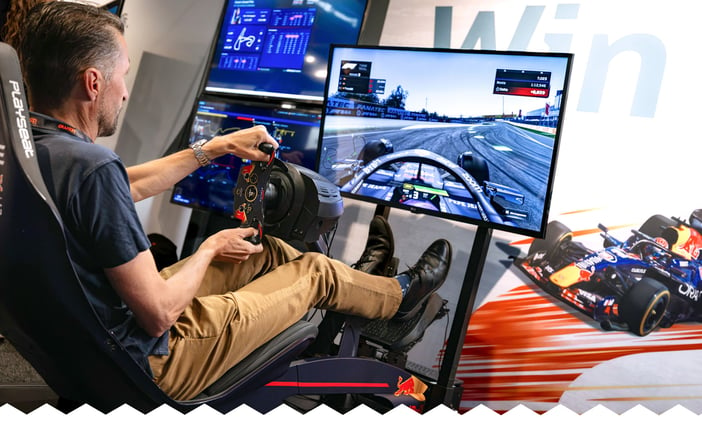
Oracle also provides the data and cloud infrastructure behind Oracle Red Bull Sim Racing: an esports team that competes in a digital simulator. Among other things, the simulator records speed, braking behavior, and throttle usage and, according to Oracle, generates an average of about 150,000 data points per second. OCI stores that data, visualizes it, and enables real-time analysis. This allows drivers on the esports team to compare laps and identify where they’re losing time. The data also feeds predictive models and aids in setup and race strategy. Data and analytical methods from the sim racing world can also provide insights that are valuable for real-world racing. Incidentally, drivers on the track also use simulations: Verstappen uses a special Formula 1 simulator to test circuits, setups, and the car’s handling, among other things.
One platform
During his presentation, Landlust emphasized that Oracle Red Bull Racing uses cloud solutions in many other areas of the team’s organization, from HR to the finance department: “And all of that on a single platform.” Data, simulations, and computing power come together seamlessly. This allows Red Bull to test and improve new designs more quickly, which, according to the CTO, shortens development time.
“GenAI has found a place in the pit lane.”
AI in the pit lane
At the end of his presentation, Landlust discussed the generative AI solutions facilitated by Oracle. “GenAI has found a place in the pit lane. We’ve developed a pit wall strategy agent that’s fed with historical scenarios and the many regulations, which, on top of that, change regularly. Everything is collected in a database, which we make accessible via a chatbot-like interface.” Using a combination of RAG (retrieval-augmented generation) and a language model, the team can rapidly search through thousands of pages of regulations and previous rulings by race officials, for example, to support a protest. “It ensures that engineers can focus on the race, rather than on the rules.”



