At Kramp, business operations revolve around speed and efficiency. If a farmer encounters a malfunctioning machine in the afternoon, it must be repairable the next morning by the machinery service company that handles the machine’s maintenance. Wholesaler Kramp delivers the necessary parts overnight to a special delivery box at the relevant machinery service company.
A smoothly functioning data analytics process is essential for such an optimal ordering and delivery process. Until January 2026, the data engineers built their own DBT models, that is, the SQL files that describe how raw data should be converted into usable datasets. Using these instructions for the data build tool (dbt), the correct data is then retrieved from a data warehouse and converted into useful dashboards using analysis and visualization tools.
Speed and quality have improved
Since last month, AI agents have been taking over most of the technical work. They assist in exploring and clarifying a data query. The agents then investigate the options for modeling it and build the dbt models. In addition, they handle the documentation and prepare the models for deployment. “During an evaluation meeting, one of our analytics engineers said that the time required to complete some difficult tasks had gone from three days to three hours,” says Oliver Meisch, head of the data department at Kramp.
Speed, however, isn’t the most important benefit, according to Meisch. Quality has improved with the use of the AI agents. “The agents draw more on business context and are better at identifying errors and assumptions in our requirements (stories).”

The analytics engineers have all been given access to an AI workstation that equipped with OpenCode as their AI coding agent. “Communication with the AI agent takes place via a chat function. The difference, however, is that this agent is fully integrated into our business environment,” explains Vincent Meijers, product owner in Kramp’s data department.
That integration was only possible because Kramp has been gradually modernizing the way its data is organized since 2022. At that time, there were about fifteen BI specialists responsible for virtually the entire chain, from managing infrastructure and collecting data to creating data models and delivering reports. “An important decision made back then was to treat working with data the same way we treat working with software.”
This led to specialization in roles such as data engineer, analytics engineer, and business analyst. Next came the technical foundation. Kramp selected and implemented a new data stack using Google Cloud, BigQuery, and dbt Cloud. Workflows were also structured according to software engineering principles, including the use of GitHub as a platform, peer reviews, separate development and test environments, CI/CD practices, and Infrastructure as Code with Terraform.
In addition, a great deal of attention was paid to the interaction between the data team and the business. Meisch: “Questions such as: what do we do with data? What is the impact on business operations? What is the roadmap? What are we going to implement? The answers to these questions must come from a shared sense of ownership of the technology and the data products.”
 “ An important decision is that we’re going to treat working with data the same way we treat working with software.”
Oliver Meisch
Solid data architecture as a foundation
Over the past two years, Kramp has implemented a domain-driven data architecture inspired by Data Mesh. In this approach, the business units that generate data remain responsible for making that data available and ensuring its quality. An added benefit is that an AI agent can now act on behalf of a user and, within Data Mesh, can only view the data to which that user has access.
The company did, however, go through a learning curve in this regard. Meisch notes that, in the beginning, data security was taken too lightly in some areas, but that has since changed. From the very start, however, a great deal of attention was paid to protecting truly sensitive data, such as specific customer information and financial figures. An AI policy group was established to discuss these issues and draw up guidelines, but also to make people aware that certain practices are not desirable. This includes, for example, sending emails or descriptions of customers that could have ethical implications.
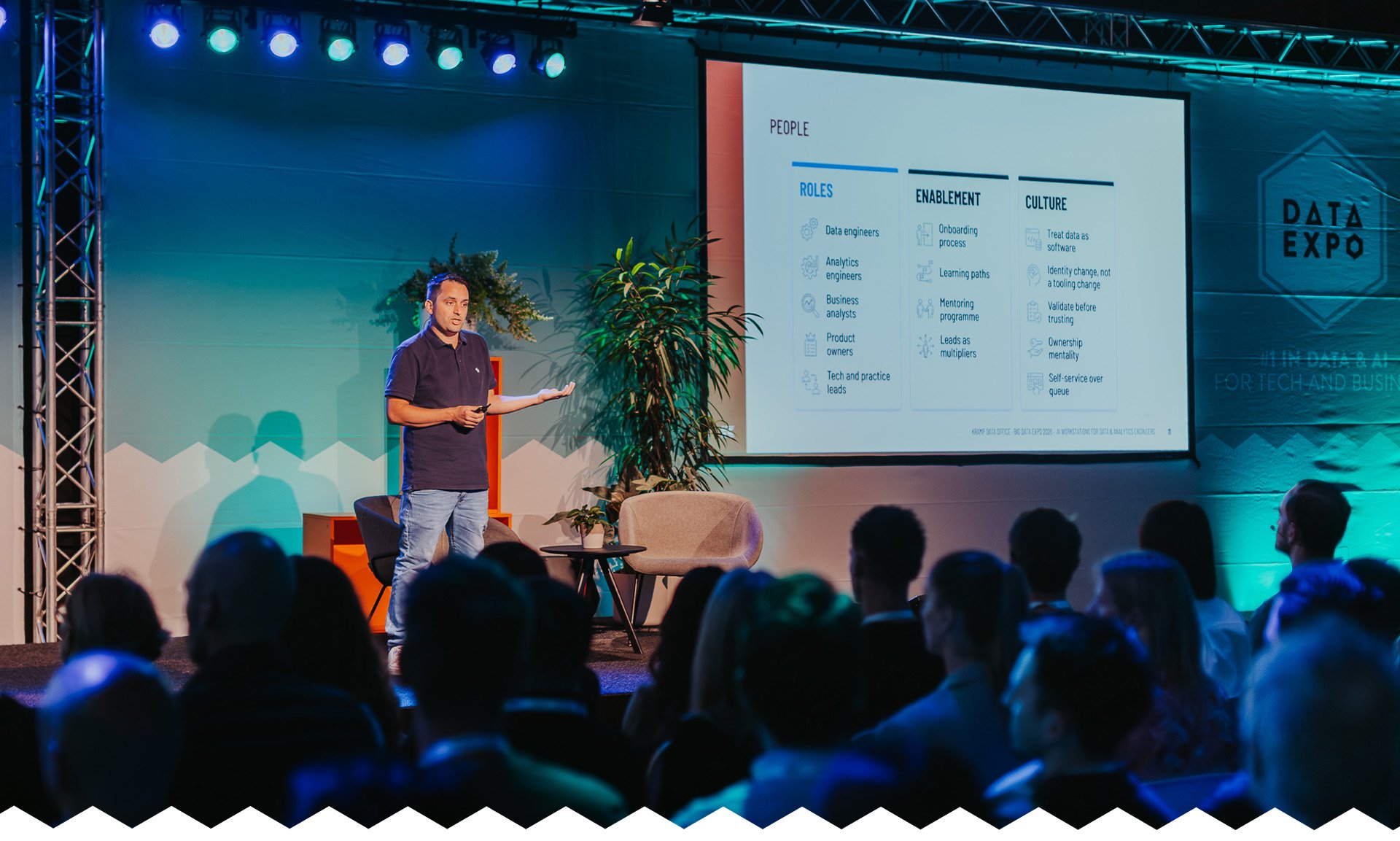
Most of the analytics team now works with AI workstations and is enthusiastic about the possibilities, Meisch says. Discussions reveal that they are spending less time on repetitive and tedious tasks, leaving more time for problem-solving and collaboration. “I always ask engineers to focus on developing their communication skills right now. Attend conferences, give a presentation. Step outside your comfort zone and engage with others. In the future, engineers will need those skills above all else to engage in dialogue with colleagues, with business stakeholders, with customers, and with the AI agents!” Meijers emphasizes that technical and subject-matter knowledge also remains very important for understanding what the AI agents do and for properly evaluating their results.
“ The difference, however, is that this agent is fully integrated into our business environment.”
Vincent Meijers
There are plenty of new challenges
Incidentally, about 20 percent of the analytics engineers at Kramp remain cautious about using the AI workstation. They are not yet convinced that the new way of working will help them. In Meijers’ experience, this has nothing to do with age, but rather with curiosity and a willingness to try new things.
Both speakers find it difficult to predict where Kramp will stand with this development in one to one and a half years due to the tremendous speed at which changes are occurring. Finally, Meijers notes that in the coming months, a great deal of attention will be focused on capturing the company’s knowledge and business logic in the data warehouse. “We see that AI can help us a great deal with this, but at the same time, we also still see a lot of fragmentation within the company.”



