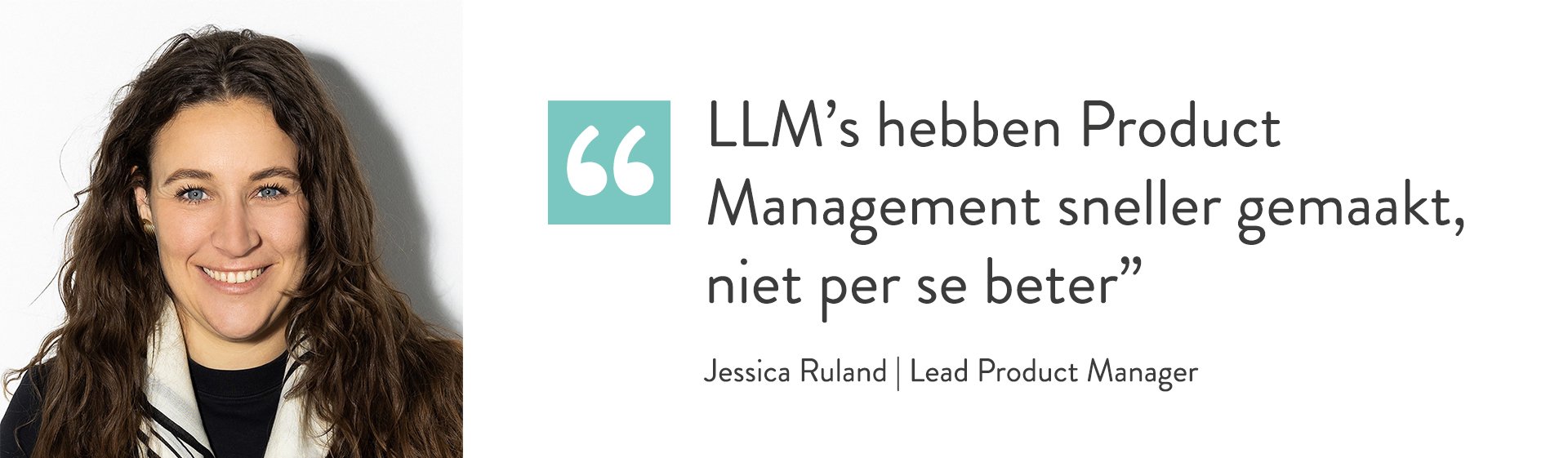
“When I open LinkedIn, I come across one doomsday scenario after another about our field,” Ruland sighs in the run-up to her presentation at Data Expo. “Product Management is dead, I read; engineering is dead, and so on. This creates an irrational fear, because thinking can never be replaced.”
Much more support
Ruland has been working in Product Management at TicketSwap, the ticket resale platform, for four years now. At the Jaarbeurs, she’ll discuss the changes in her field brought about by LLMs, using concrete examples from the Amsterdam-based company, which now operates in dozens of countries. “Don’t get me wrong: there really is a shift taking place in the industry. But the core of the Product Management process has remained the same: identifying opportunities, validating them, building, and scaling. We’ve just gained a lot more support. LLMs have made our work faster—and therefore more efficient—not necessarily better.”
From pull to push
LLMs are accelerating data-driven work at TicketSwap, Ruland explains. “When it comes to analytics and experiments, for example, data is scattered across all sorts of different tools, such as Dovetail and Amplitude. Previously, we had to extract data from those tools to be able to do anything with it. Now we use agents that retrieve exactly the requested data from everywhere, consolidate it, and present it. We’re shifting from a ‘pull’ to a ‘push’ model. For me, the added value lies in what this frees up: since we no longer spend most of our time searching for and consolidating data, we can focus on using it—building hypotheses, making decisions, and applying judgment. We’re also using LLMs for validation and decision-making, partly because the pace of development simply demands it.”
 “The focus is shifting to Product Discovery”
Accelerates Execution
LLMs have, above all, drastically changed the development process, Ruland continues: “Engineering now happens primarily in collaboration with Claude Code, which makes execution so much faster. Sometimes, within a week of starting, I already have someone at my desk asking, ‘What’s next?’ So we’re spending less time on the actual building and more on what we need to build. The focus is shifting further and further toward the front end of the process, toward Product Discovery. Continuous validation is becoming even more important.”
New Solutions
LLMs aren’t just changing the way Product Managers work, according to Ruland—they’re also enabling new solutions for users. “People who want to sell a ticket used to have to manually search for the event on the right date and so on. Now customers can simply upload a ticket, after which an LLM identifies it and posts the listing online.”
Context and Taste
Back to the workplace: Ruland wants to counter the narrative that AI makes jobs obsolete. She explains:“The question of what we should build has therefore become more important: does a solution truly align with what the user needs, what the market demands, and what TicketSwap stands for? Making sound decisions on these three points requires judgment. Context and taste come into play here, and you can’t leave that up to technology.” She clarifies this with an example: “A partnership with (competitor, ed.) Ticketmaster was suggested to us, but given the context, we wouldn’t be quick to do that.”
Another example: “AI helps categorize certain events, but that’s a delicate balance. For example, we deal with events featuring tribute bands and artists. If we’re not careful, we could end up sending out push notifications saying, ‘2Pac is performing!’” The rapper has been dead for nearly thirty years.
When it comes to taste, Ruland is referring to the ability to sense what the right product is at the right time—for the user, the market, and the company’s strategy. “That’s not something you can always back up with data, and that’s exactly why an LLM can’t take over.”

The Product Manager of 2026
What qualities must a good Product Manager of 2026 possess? Ruland pauses to think for a moment and then says: “Asking the right questions—that’s truly decisive these days. When it comes to validation, it’s even more important that you make the right decision.” It all comes down to filtering—separating the wheat from the chaff. “You shouldn’t take everything at face value, and above all, you need to be aware of what you don’t know. The age-old adage ‘garbage in, garbage out’ certainly applies in the age of AI as well.”
There’s a risk that companies will rush to build solutions that nobody wants, notes TicketSwap’s Product Lead. “We don’t yet fully understand the damage this could cause in the medium term, but I don’t want to underestimate it.”
“Roles are becoming much more fluid”
Doing more independently
Another consequence of the rise of LLMs is that product managers and designers are increasingly taking on some of the engineers’ roles. “I’m able to do more and more on my own within the process of brainstorming, developing, and validating,” says Ruland. “We’re working on being able to set up experiments on our own, without engineers. That way, we can create the first versions of solutions, build prototypes, and test them. The roles are becoming much more fluid. When you scale up, of course, you absolutely need engineers. I’m convinced that all existing areas of expertise within the product development cycle will remain necessary, even five years from now. The best people have the skills to contribute to the entire cycle.”
At Data Expo, Ruland will use concrete examples to illustrate that while much has changed in her field, much has also remained the same.

At Data Expo, Jessica Ruland will speak on Thursday, September 10, at 3:15 p.m. about Product Management at TicketSwap.


